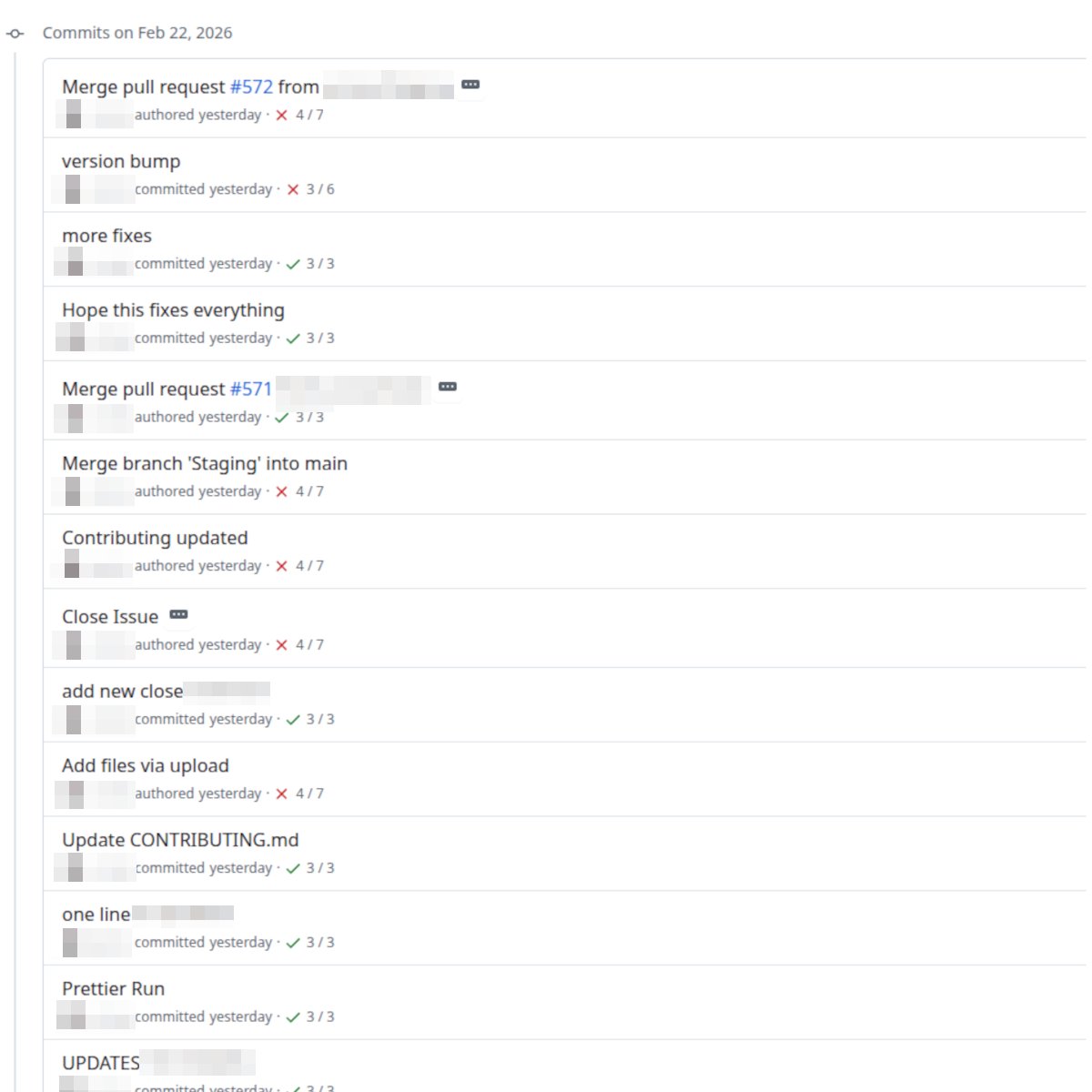
A piece of software jumps from version 1.0 to version 31.5.6 within three weeks. The changelog is long, the feature list impressive, the release frequency high. At first glance, it looks like a team that delivers.
At second glance, different questions arise. Not about features, but about structure. Are there automated tests? Is there monitoring that detects anomalies? Who decides during an incident whether a rollback is needed? And who bears the responsibility when a release causes damage in production?
High release frequency shows motion. It doesn't show whether anyone has the full picture. This isn't a speed problem. It's a structural problem.
- High release frequency is not a quality indicator. Without counterforces, speed becomes an operational risk.
- DORA shows: High deployment frequency and stability are possible together - when the underlying structure is sound.
- Those who release fast don't need less control, but a different kind: automated, built-in, with clear ownership.
Version numbers don't tell a quality story
Semantic Versioning is a convention for labeling changes. Major, Minor, Patch. It describes what has changed, not whether the change is safe, tested, or well thought through. A high version number is not a seal of quality. It shows activity.
The pattern behind it is well known: high output with crumbling structure underneath. Like a building erected in record time. Impressive from the outside. Whether the structural engineering holds up only shows under load. In software development, "under load" usually means: in production, with real users, at the worst possible time.
Two prominent recent examples demonstrate that speed without counterforces has real consequences.
In July 2024, CrowdStrike provided a concrete example of what happens when speed and verification depth diverge. A faulty content update for the Falcon sensor took down approximately 8.5 million Windows systems within 78 minutes and caused billions in economic damage. The technical cause: a template type defined 21 input fields while the associated sensor code expected 20. Validation used wildcard matching and let the error pass. Not a complex attack vector. A structural failure in the quality process.
In November 2025, an outage at Cloudflare showed how far the impact can reach when central infrastructure fails. A change to database permissions caused an internally generated configuration file to exceed its expected size. The bot management module crashed, the HTTP proxy served mass 5xx errors. For nearly six hours, numerous internet-based services and websites were unavailable or severely degraded. Cloudflare sits in front of roughly 20% of the web. When this single node fails, it's not one service that goes down. It's a piece of infrastructure that thousands of services depend on.
The pattern isn't new. But it's becoming more relevant because the tools are getting faster. Those who increase the frequency without scaling up the verification mechanisms don't increase capability. They increase the attack surface.
Where missing counterforces become visible
Speed alone is neutral. It becomes a problem when the mechanisms that limit its impact are missing. Five areas show particularly early in practice whether an organization can structurally keep up.
1. Tests only cover the happy path. The result: errors only surface in production. Regression tests, edge cases, integration tests are missing or get skipped under time pressure. The NIST Secure Software Development Framework (SP 800-218) requires systematic verification and validation practices as a baseline requirement for every release process.
2. Monitoring captures logs, not signals. Problems aren't detected - they're reported by users. Anyone without alerting on error rates, latency, or behavioral anomalies only learns about outages through support tickets.
3. Ownership is unclear. In an emergency, this leads to delays. When three teams debate who triggers the rollback during an incident, time passes that makes the problem worse. Ownership means: one person can decide without seeking approval first.
4. Security basics are neglected. The attack surface grows with every release that passes without a dependency scan, without secret detection, and without mandatory review for security-relevant changes. The BSI TR-03185 requires demonstrable security measures across the entire software lifecycle.
5. There is no stop-the-line culture. Velocity becomes an end in itself. When nobody can stop a release because the sprint plan doesn't allow for it, speed is no longer an advantage. It becomes an obligation that systematically subordinates quality.
What stable teams do differently
A common misconception: slower delivery means safer delivery. The data shows the opposite. Nicole Forsgren, Jez Humble, and Gene Kim document in Accelerate that the highest-performing teams deploy both more frequently and more stably. Not despite the frequency, but because of the structure that enables it.
The DORA State of DevOps Report 2024 confirms this with current data. The highest-performing teams achieve low change failure rates with short recovery times - and deploy more frequently than all other groups. The difference isn't speed, but the mechanisms that catch errors before they cause damage: automated tests, feature flags, canary deployments, clear rollback processes.
A notable finding from the same report concerns the use of AI in the development process. According to the report, a 25% increase in AI adoption correlates with an estimated 7.2% decline in delivery stability. A plausible explanation: more generated code per unit of time means larger changesets that are harder to review, test, and roll back.
Continuous Delivery doesn't work because teams check less. It works because they've automated checks, run them early, and built them into every step.
The implication is clear: speed is not a risk factor as long as the counterforces grow proportionally. But it becomes one as soon as output rises while verification depth stays the same.
More output creates more attack surface
AI-powered development tools make it easier to generate code. But output is not synonymous with quality. The speed at which code is produced changes the requirements for the processes that verify it.
Pearce et al. (2022) examined the security of GitHub Copilot-generated code across 89 scenarios. Result: approximately 40% of the 1,689 generated programs contained vulnerabilities, including SQL injection, path traversal, and missing input validation.
A large-scale study from 2025 analyzed 7,703 AI-generated files from public GitHub repositories across multiple code generators. The authors identified 4,241 CWE instances spanning 77 vulnerability types. Most common: missing access control, insecure cryptography, and insufficient input validation.
When the volume of generated code increases but review capacity and test coverage stay the same, the attack surface grows with every release. The question isn't whether AI-generated code is insecure. The question is whether existing verification processes can keep pace with the increased volume.
Those who increase output must scale verification capacity proportionally. Otherwise, the ratio between generated and verified code shifts in a direction that creates operational risk.
Quick check: Release readiness in 5 questions
Whether an organization is structurally prepared for high release frequency can be narrowed down with five questions. None of them require deep technical analysis. All of them target structure and ownership.
- Can every release be rolled back automatically without someone having to intervene manually at night?
- Is there monitoring that automatically flags anomalies in error rates, latency, or usage patterns?
- Is it clearly defined for every component who decides and acts during an incident?
- Are dependency scans and security checks run automatically in the CI/CD pipeline?
- Can a team member stop a release when quality criteria aren't met?
If more than two of these questions are answered with no, the release frequency is probably higher than the organization's ability to control its impact.
| Counterforce | Owner | Automated? |
|---|---|---|
| Automated tests | ___ | yes / no |
| Monitoring & alerting | ___ | yes / no |
| Rollback capability | ___ | yes / no |
| Security scans (SAST/DAST) | ___ | yes / no |
| Incident ownership | ___ | yes / no |
Speed requires ownership
The problems described here aren't a technology problem. Tooling for tests, monitoring, and security scans exists - often as open source, often integrable into existing pipelines. What's missing is rarely the technical capability. What's missing is ownership: a person or team responsible for ensuring these mechanisms exist, work, and are followed.
Organizations that treat speed as a value without simultaneously defining ownership for stability are building a system that fails under load. Not because it's too fast. But because nobody is responsible when it needs to slow down.
The EU Cyber Resilience Act (CRA) will become mandatory for all products with digital elements from December 2027. It requires, among other things, documented processes for vulnerability management, security updates across the entire lifecycle, and demonstrable risk assessments before market launch. The BSI TR-03185 specifies these requirements for the German market. Anyone without a structure for secure releases today will need one by then at the latest.
Release speed is not a value in itself. It's the result of structure that works. Speed is an advantage when structure supports it. Without structure, it's just acceleration.
Sources
- CrowdStrike: Falcon Content Update Remediation and Guidance Hub (2024)
- Cloudflare: Cloudflare outage on November 18, 2025
- BSI: Technical Directive TR-03185
- NIST: SP 800-218 Secure Software Development Framework (SSDF)
- European Commission: EU Cyber Resilience Act
- Forsgren, N., Humble, J., Kim, G.: Accelerate: The Science of Lean Software and DevOps, IT Revolution Press, 2018
- DORA Team: State of DevOps Report 2024
- Pearce, H. et al.: Asleep at the Keyboard? Assessing the Security of GitHub Copilot's Code Contributions, IEEE S&P 2022
- arxiv: Security Vulnerabilities in AI-Generated Code: A Large-Scale Analysis of Public GitHub Repositories, 2025